
In the letter issued, considering the last night attacks by Pakistani forces in Jammu and Jaisalmer regions, the provision also authorises the use of local authority funds for such emergency measures, giving them precedence over other financial obligations.
The United Nations Security Council (UNSC) has strongly condemned the terrorist attack in Jammu and Kashmir, urging that those responsible be held accountable and brought to justice. The Council issued a press statement expressing its deepest sympathy to the victims' families and calling for all states to cooperate in combating terrorism. UN Secretary-General Antonio Guterres also expressed concern about the situation, urging India and Pakistan to exercise restraint.
Presenting the full text of Prime Minister Narendra Modi's address to the nation on May 12, 2025, in which he dictated India's new doctrines on countering terrorism.
'India has been preparing for the last 15 days... it won't be easy for Pakistan if it tries to dominate escalation.'
'Every decision India makes along the LoC, it must also consider implications along the LAC.'
Indian Armed Forces brought down a number of these drones using kinetic and non-kinetic means.
The UN Security Council will hold closed consultations on Monday on the situation between India and Pakistan after Islamabad sought an emergency meeting on the issue. Pakistan, which currently sits as a non-permanent member of the council, requested the meeting in light of rising tensions between the two countries following a terror attack in India. The meeting comes after India's foreign minister spoke with all council members except China and Pakistan, emphasizing the need to bring perpetrators of the attack to justice. The Pakistani envoy has argued that the situation in Jammu and Kashmir poses a threat to regional and international peace and security, justifying the need for a council discussion.

'Pakistan has been successful in convincing the rest of the world that the Pakistani nuclear terrorists are meant to target only India. This is myopia at its worst,' says Colonel Anil A Athale (retd).
'Unfortunately, India and Pakistan could learn a 'lesson' from this conflict that will make them more likely to use these weapons against each other in the future.' 'Rounds of missile and drone attacks could be more routine features of their hostility, just like artillery fire has become a familiar fact of life along the Line of Control.'
'India enjoys conventional superiority, but nuclear deterrence imposes clear boundaries.'

Emphasising the importance of sustaining food and energy security, the G20 leaders called for the "cessation of military destruction or other attacks on relevant infrastructure".

While advancements in biotechnology hold immense promise for health and innovation, they also come with significant risks if misused.
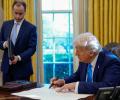
The stage may be set for a recalibrated US-Iran relationship, suggests Ambassador M K Bhadrakumar.
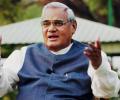
It was good fortune for India to have Atal Bihari Vajpayee lead the government at a crucial moment in our history. He avoided India meeting the fate of Iraq or Ukraine, asserts military historian Colonel Anil A Athale (retd).

The United States Department of Defence has announced that it will pursue a modern variant of the B61 nuclear gravity bomb, designated the B61-13, pending Congressional authorisation and appropriation.
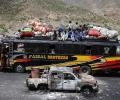
'No military offensive by Pakistan will end the insurgency in Balochistan without simultaneous, concerted efforts toward political dialogue to de-escalate tensions.'
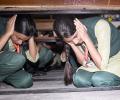
India conducted nationwide civil defence mock drills simulating multiple hostile scenarios like air raids, fire emergencies, and rescue operations across several states and union territories. The drills, dubbed 'Operation Abhyaas,' aimed to enhance emergency preparedness in light of recent terror attacks. The exercises involved coordinated efforts by various agencies, including civil defence personnel, police, fire and emergency services, and the military. Mock drills were conducted at various locations, including railway stations, malls, and high-rise buildings, showcasing the response capabilities of authorities in different emergency scenarios. The drills highlighted the importance of public awareness and cooperation in dealing with real-time emergencies.

India has been ranked below its two nuclear-armed neighbours -- Pakistan and China -- in the list of countries with a weak nuclear material security in the world, according to a US-based think-tank.

Reports (not denied by India) that the USA had 'for the first time provided real-time details to their Indian counterparts on the Chinese positions and force strength in advance of a PLA incursion' into Tawang at the LAC in December 2022, helping India thwart China's expansionist designs, show how operationally effective the USA-India friendship has become on the ground. A engaging excerpt from Sreeram Chaulia's must-read new book, Friends: India's Closest Strategic Partners.

During last week's Nuclear Security Summit, President Obama asked the media to leave and then screened videos depicting plausible scenarios pertaining to nuclear terrorism.
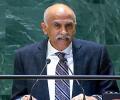
The first issue in engaging with Pakistan is the cessation of terrorism, India's envoy at the United Nations said, underlining that India has been a long-standing victim of cross-border and global terrorism and has zero tolerance towards the scourge.
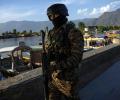
The 'mediation' by the United States from behind the scene on the diplomatic track appears to be once again working, which calls on both Delhi and Islamabad to show restraint and pull back from a military confrontation, notes Ambassador M K Bhadrakumar.
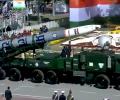
India showcased its indigenous short-range tactical missile Pralay for the first time at the Republic Day parade on Sunday. The missile, developed by the Defence Research and Development Organisation (DRDO), is capable of carrying a nuclear warhead and has a range of 150 to 500 kms. The parade featured an array of other indigenously built missiles, surveillance systems, and weapon systems, reflecting India's growing military prowess. The DRDO displayed its latest innovations for national security, including the quick reaction surface-to-air missile, airborne early warning and control system, and drone detect, deter and destroy system.
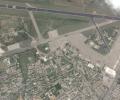
'We do not want to fall into a trap of uncontrolled escalation or all out conflict.' 'When the need arises we will do that.'

'He is not that crazy.' 'He is driven by a deep sense of Russian power have been diminished.'

The defence ministry said the test-flight was carried out on Wednesday evening and it met all the trial objectives, validating the reliable performance, as confirmed from the data captured by a number of range sensors deployed at different locations.
We bring forth to our readers the list of nations sitting on a nuclear stockpile, based on the study findings:
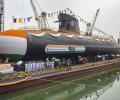
The status of the current submarine force level is alarming and we need to address the threat perceptions expeditiously. Critical decisions pertaining to national security cannot be delayed any further due to the rapidly changing maritime threat perceptions and growing strategic importance of the Indian Ocean region, asserts Commodore Venugopal Menon (retd).

Beijing is brazenly thumbing its nose at the international non-proliferation regime it signed up to less than a decade ago, says Nitin Pai

Dominic Xavier offers his take on Vladimir Putin's nuclear threats.

The government has approved the construction of two indigenously designed nuclear attack submarines and is expected to ink contracts next month to procure 26 naval variant of Rafale jets and three Scorpene submarines, Navy Chief Admiral Dinesh Tripathi said on Monday.
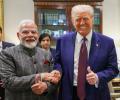
Modi lived up to his declaration that his visit was purely meant to strengthen India's relationship with the US, but there may be situations in which our silence on some issues will haunt us in the future, cautions Ambassador T P Sreenivasan.
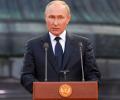
'When the war against Ukraine that Putin started is not going the way he was expecting it to and his military options are getting onerous, a bit of nuclear sabre rattling is what he hopes will turn things around for him and Russia.'

It's a strategic approach in which the country's military and defence mechanisms evolve continuously in tandem with emerging threats. The new strategy anticipates events and prepares to counter those proactively.
"The enemies of the country want to project the militancy in the country as indigenous and for this purpose, they have been recruiting some local youth for arms training," he said.
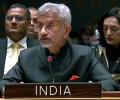
India abstained on two UN General Assembly resolutions calling for a de-escalation, an early cessation of hostilities and a peaceful resolution of the war against Ukraine. The resolutions were adopted on the third anniversary of the Russia-Ukraine conflict, with the UN Secretary General stressing that the war in Ukraine stands as a grave threat to the peace and security of Europe and the core principles of the United Nations.
United States President Barack Obama on Tuesday warned that the threat of nuclear weapons remains a challenge as there are still "too many bad actors in search of these dangerous materials", asserting that the world's security depends on the actions that the global community takes.
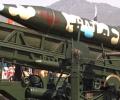
'The Indian gung-ho leadership may like to think about it, there should never ever be a doubt in anyone's mind, friend or foe, that Pakistan's operationally ready nuclear capability enables every Pakistani leader the liberty, the dignity and the courage to look straight into the Indian eye and never blink.'
 © 2026 Rediff.com - Investor Information - Advertise with us - Disclaimer - Privacy Policy - Sitemap - Feedback - About us - Terms of use - Grievances